Architectural Typography: Integrating the Ramigad Lenmad Font into High-Concept Design Workflows
In the realm of professional design, typography often serves as the silent workhorse, supporting imagery without stealing the show. However, there are specific moments in a creative workflow where text must transcend its role as a mere vessel for information and become the primary visual element. This is where the Ramigad Lenmad font enters the conversation. It is not designed for body copy or simple legibility tasks; rather, it is a specialized instrument for complex layering and intricate detail. Understanding how to deploy this typeface effectively requires a shift in design thinking, moving from standard typesetting to architectural composition.
Understanding the Visual Mechanics of Ramigad Lenmad
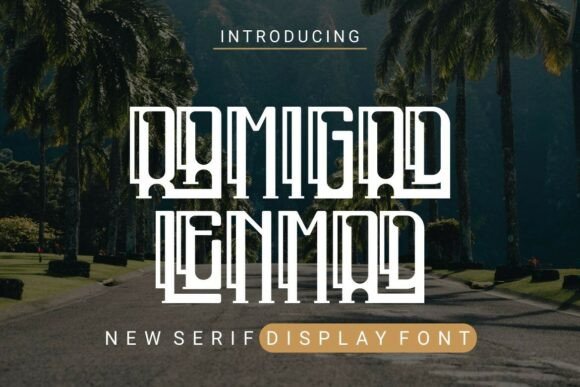
At its core, the Ramigad Lenmad typeface is a serif display font that pushes the boundaries of traditional typography through its innovative "echo effect." Unlike standard serif fonts that rely on thick and thin strokes for contrast, Ramigad Lenmad utilizes overlapping lines that create a mesmerizing, three-dimensional look. This architectural rhythm makes the font feel simultaneously ancient and futuristic. For designers, this means the typeface carries a heavy visual weight; it demands attention and requires careful handling to avoid overwhelming the composition.
The structural integrity of the font is defined by its tall, condensed form and layered serifs. When viewing the characters, one can see a sense of prestige and mystery derived from these overlapping vectors. This makes the Ramigad Lenmad font an ideal candidate for projects where the text itself serves as a standalone work of art. It is particularly suited for experimental music posters, high-concept branding, and artistic exhibition titles where the aesthetic value of the letterforms is just as important as the message they convey.
Strategic Implementation: When to Use Ramigad Lenmad
Integrating a display font like Ramigad Lenmad into a project requires precise timing within your creative workflow. It is rarely a font you choose at the start of a project without a clear vision. Instead, it is best utilized during the concept phase of high-stakes visual assets. If you are designing a hero image for a website, a title sequence for a video, or the cover of a magazine, Ramigad Lenmad offers a solution for creating immediate visual hierarchy.
Consider the decision-making process: once the core message and color palette are established, the choice of typography defines the tone. If the goal is to project an intellectual and highly creative aesthetic, Ramigad Lenmad fits perfectly. It interacts with other design elements by acting as a focal point. Because of its intricate linework, it pairs best with simple backgrounds. Using a busy background will result in visual noise, whereas a clean, flat background allows the three-dimensional nature of the font to breathe and stand out.
Practical Workflow for Integration
To effectively use this typeface, follow a practical implementation process. First, ensure your design environment supports advanced typography features. The Ramigad Lenmad typeface comes with PUA encoding, which ensures that all special characters and decorative elements are easily accessible. This is a crucial workflow consideration; you do not need additional complex software to access the full glyph set, allowing for a smoother design process.
- Preparation: Before importing the font, organize your project layers. Because the font has an echo effect, you may want to separate the text from background elements to manage clipping masks or blend modes later.
- Compatibility: Verify that your output medium supports the fine details of the font. It renders best on high-resolution screens and print. Avoid using it for small-scale applications like footnotes or mobile UI text, as the intricate details will blur.
- Execution: When typing, consider the tracking. The condensed structure of Ramigad Lenmad often benefits from slightly increased letter spacing to prevent the overlapping lines from merging into an unreadable mass, though this depends on the specific size and application.
Pairing and Composition Techniques
A common challenge when using ornate fonts is maintaining readability and balance. The Ramigad Lenmad font is highly decorative, which means it requires a counterbalance in your layout. The most effective workflow involves pairing this typeface with a clean, neutral sans-serif font for any supporting text, such as subheadings or body copy. This contrast ensures that the main title pops while the rest of the information remains accessible.
Furthermore, consider the interaction between the text and negative space. The "echo effect" creates a sense of movement and density. To maximize impact, treat the typography as a graphic element. This might mean breaking the grid slightly or allowing the text to bleed off the edge of the canvas. In a branding context, using Ramigad Lenmad for a logo or a brand mark requires vectorizing the text after the layout is finalized. This ensures that the complex layering remains intact regardless of where the asset is deployed.
Long-Term Use and Brand Consistency
For entrepreneurs and brand managers, consistency is key. If you decide to adopt the Ramigad Lenmad typeface as part of a brand identity, particularly for a luxury or avant-garde brand, document its usage strictly. Define which contexts it appears in—perhaps only for event titles or specific campaign headers. Because the font has such a distinct personality, overuse can dilute its impact. It works best as a spice, not the main ingredient, in a long-term branding strategy.
Ultimately, Ramigad Lenmad is a tool for those who want their text to be impossible to ignore. It bridges the gap between typography and sculpture, offering a unique solution for creators who view design as a process of building rather than just arranging. By respecting its complexity and integrating it thoughtfully into your workflow, you can leverage this font to create designs that feel both prestigious and deeply artistic.