Teacher Font: Integrating Educational Charm into Your Creative Workflow
In the landscape of design assets, few elements capture the specific energy of the educational environment as effectively as a thematic typeface. Teacher Font is not merely a collection of letters; it is a decorative display alphabet engineered to function as a visual shorthand for learning, growth, and school spirit. Understanding how to integrate such a specialized asset into your production pipeline—whether you are a freelancer, an educator, or a small business owner—requires a look beyond aesthetics and into practical application.
The Anatomy of Teacher Font
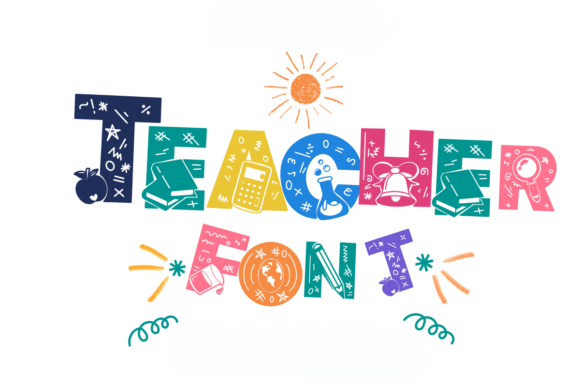
At its core, Teacher Font is built from bold, blocky letterforms. These are not standard serifs or sans-serifs; instead, each glyph acts as a miniature canvas. The design language relies on sturdy proportions and slightly squarish shapes, which provide a solid foundation for the intricate details contained within. The defining characteristic is the inclusion of education motifs—books, pencils, bells, calculators, magnifiers, and globes—rendered in lively linework inside the solid shapes of the letters. This construction ensures that the typeface remains readable at poster scale while retaining its charm on smaller worksheets.
The technical specifications of the font support its versatility. With even stroke weight and wide counters, the icons inside the letters remain crisp and legible. The consistent cap height and disciplined spacing allow words to lock up neatly, a critical feature when designing headers or bulletin board titles where alignment is paramount. Furthermore, the design embraces rounded corners and simplified diagonals, softening the tone to make it approachable and kid-friendly.
Pre-Production: Assessing Project Fit
Before incorporating Teacher Font into a project, it is essential to evaluate where it fits within the broader context of your deliverable. This font is specifically designed for color play and visual impact, making it ideal for the "energy phase" of a project rather than the "data phase." It translates cleanly to vinyl cutting and print, which opens up specific workflows for physical product creation.
Consider the following use cases where Teacher Font serves as a primary asset:
- Classroom Décor and Bulletin Boards: The sturdy letterforms are built to withstand scaling. When preparing files for large-format printing, the font’s disciplined spacing prevents the "crowding" effect often seen in decorative typefaces.
- Event Branding: For school carnivals, science fairs, or book fairs, the font provides instant thematic recognition without the need for extensive illustration overlays.
- Digital Assets: Book app titles and educational website headers benefit from the font's ability to convey "learning" instantly, reducing the cognitive load on the viewer.
If your project requires long-form reading or complex data presentation, Teacher Font should be reserved strictly for headers or accent text. Its blocky nature, while readable at display sizes, is not optimized for body copy. Identifying this boundary early in the planning stage prevents workflow bottlenecks later.
Workflow Integration and Execution
Integrating a display font into a production workflow involves more than just installation. It requires a strategy for how the asset interacts with other design elements, particularly color and layout.
Color Application and Layering
Teacher Font is designed to welcome flat fills, outline treatments, and layered palettes. In a practical workflow, this means you can maintain a single font file but achieve multiple visual outcomes. For instance, in a sticker production line, you might use a solid fill for the primary set and an outline treatment for a secondary "coloring page" version. This approach maximizes the asset's utility without increasing file management complexity.
When working with layered palettes, ensure your design software supports independent manipulation of the glyph's interior motifs. This allows you to highlight specific educational elements—perhaps coloring the "pencil" motif yellow and the "book" motif blue—adding depth to the design. This level of detail elevates a standard worksheet header into a polished, professional piece of educational material.
Compatibility with Production Methods
The font's architecture is optimized for specific production methods. Because the letterforms are built from bold, solid shapes with simplified diagonals, they are exceptionally well-suited for vinyl cutting. Intricate serifs or hairline strokes often cause issues with weeding and material tearing in vinyl workflows; Teacher Font avoids these pitfalls entirely.
For print workflows, particularly in activity packs or T-shirt designs, the wide counters ensure that ink does not bleed into the negative space, maintaining clarity even on lower-resolution outputs. When preparing files for offset or digital printing, standardizing the color profiles of the embedded motifs ensures consistency across different batches of merchandise.
Operational Efficiency and Organization
For professionals managing multiple clients or a high volume of educational content, organization is key. Treat Teacher Font as a specialized tool in your kit, categorizing it alongside other thematic assets rather than general-purpose typefaces.
Create template files that pre-load the font with your standard color palettes. This is particularly useful for freelancers or agencies servicing the education sector. By establishing a "School Spirit" template that utilizes Teacher Font, you can rapidly prototype lesson covers, badges, and stickers, reducing the time spent on setup for each new assignment.
Furthermore, consider the "upbeat" personality of the font when conducting quality control. If a design feels too corporate or sterile, Teacher Font can be the corrective element that introduces the necessary school-spirited energy. Conversely, if a design is already visually noisy, the font’s disciplined spacing helps anchor the chaos rather than adding to it.
Long-Term Use and Adaptability
A typeface like Teacher Font offers longevity because it taps into a timeless theme: the tools of education. While trends in graphic design shift, the visual language of books, globes, and pencils remains constant. This makes the font a sound investment for long-term asset libraries.
Over time, you may find new applications for the font beyond the obvious. For example, a productivity blogger might use the "calculator" or "magnifier" glyphs as custom bullet points for articles on personal finance or research methods. A small business owner selling educational toys could use the font to create cohesive branding across packaging, social media headers, and thank-you notes.
By viewing Teacher Font not just as a static alphabet but as a library of educational iconography contained within a typeface, you unlock a higher level of utility. It becomes a connector between text and imagery, streamlining the design process by reducing the need for separate icon sets. This efficiency, combined with its friendly, approachable aesthetic, makes it a practical and valuable component of any creative workflow focused on the education sector.