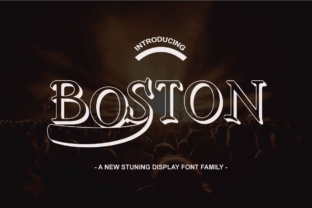
Boston Family Font: Integrating a Versatile Display Family into Your Creative Workflow
Understanding the Boston Family Font Ecosystem
In the world of design and content creation, typography is rarely a static choice; it is a functional tool that dictates the tone and hierarchy of a project. The Boston Family Font stands out not merely as a typeface, but as a comprehensive display family designed to bridge the gap between aggressive marketing materials and refined editorial design. When professionals look for a font that offers both "impact" and versatility, they are often looking for a solution that minimizes the need to source multiple typefaces for a single campaign. Boston Family fulfills this role by providing a cohesive structure that works across various mediums, from high-resolution digital screens to textured print stock.
The primary strength of this font family lies in its design DNA. It is categorized as a display family, meaning it is engineered to command attention at larger sizes, such as headers, banners, and title cards. However, unlike many display fonts that sacrifice functionality for style, the Boston Family is built with enough legibility to function in short-form body copy or call-to-action buttons. For the modern creator—whether a freelance graphic designer, a small business owner managing their own branding, or a marketer crafting ad copy—understanding this duality is the first step in planning a successful project. You are not just downloading a font; you are acquiring a toolkit that offers multiple weights, styles, and alternates to solve visual problems.
Aligning Typography with Project Goals
Before opening your design software, the integration of the Boston Family Font begins at the planning stage. Typography should not be an afterthought chosen five minutes before a deadline; it should be a foundational decision that aligns with the project’s communication goals. If you are launching a bold marketing campaign, the "impact" characteristic of Boston Family makes it an ideal candidate for the primary visual hook. Conversely, if you are designing a sophisticated lookbook, the family’s varied weights allow for a more subtle, elegant application.
Consider the workflow of a typical branding project. The initial phase involves mood boarding and defining the visual identity. During this stage, you should test the Boston Family against your brand guidelines. Does the geometric structure of the letterforms complement your logo? Does the x-height align with your readability standards? By making these decisions during the "preparation" phase, you prevent bottlenecks during execution. For instance, a freelancer pitching a rebrand to a client can use mockups featuring Boston Family to demonstrate how a unified type system can elevate the client's perceived authority, effectively selling the concept before the design work even begins.
Compatibility and Technical Preparation
Technical feasibility is a critical component of the planning process. The Boston Family Font is designed for compatibility, but a smooth workflow requires checking the specific formats included in the package (such as .OTF, .TTF, or .WOFF). If your workflow involves web development, you must ensure the web fonts are optimized for fast load times. For print designers, verifying that the font includes the necessary glyphs for your specific language requirements is essential to avoid last-minute scrambling.
Furthermore, consider the ecosystem in which the font will live. If you are a small business owner creating materials in Canva, you need to know how to upload and access the font library efficiently. If you are a professional using the Adobe Creative Cloud suite, understanding how to sync the fonts via Adobe Fonts or manage them through a local font manager ensures that the typeface is instantly accessible when you switch between Illustrator, InDesign, and Photoshop. This technical preparation eliminates friction, allowing the creative process to flow without interruption.
Creating Hierarchy and Visual Flow
The true utility of the Boston Family Font is realized during the execution phase. A common challenge in design is establishing a clear hierarchy—guiding the viewer’s eye from the most important element to the least. Because Boston is a "family" rather than a single font file, it allows for significant contrast without visual dissonance. A practical implementation strategy involves pairing the boldest weight for the main headline with a lighter weight for sub-headers, and potentially a standard weight for pull quotes.
For example, in a digital marketing workflow, you might be designing a landing page. The goal is conversion. You can utilize the high-impact nature of Boston Family for the "Hero" section headline to grab immediate attention. As the user scrolls down to the features section, you might switch to a medium weight to maintain energy while improving readability for slightly smaller text. This approach maintains brand consistency while solving the functional problem of information density. The font family acts as a visual glue, holding disparate sections of a page together into a cohesive narrative.
Print vs. Digital Application
While the font performs well digitally, its application in print requires a different set of considerations. When working with physical assets—business cards, brochures, or merchandise—the "stunning" aesthetic of Boston Family translates into a tactile quality. The curves and terminals of the letters often trap ink differently than standard sans-serifs, adding a level of sophistication to print media.
In a workflow involving large-format printing, such as trade show banners or posters, the legibility of the font at a distance is paramount. Here, you should utilize the heaviest weights available in the Boston Family. The "load of extras" mentioned in the font's description often includes stylistic alternates or ligatures that can be used to customize the look of a logo or a main title, preventing it from looking generic. This customization step is crucial for brands looking to stand out in a crowded physical space. It transforms a standard layout into a bespoke design piece with minimal effort.
Streamlining Team Collaboration
For agencies and teams, the Boston Family Font serves as a standardized asset that streamlines collaboration. When everyone on a team—from the copywriter to the web developer—is working with the same font files, the risk of "font substitution" errors (where a design breaks because a team member doesn't have the specific font installed) is drastically reduced.
Implementing a font management protocol is a practical step here. This might involve creating a shared digital asset library where the Boston Family files are stored alongside brand guidelines. When a new team member onboards, they install the font package immediately. This preparation ensures that whether a team member is editing a social media graphic in Figma or typesetting a report in Microsoft Word, the output remains consistent. This consistency is vital for building trust with a client or audience, as visual fragmentation can subconsciously signal a lack of professionalism.
Iterating and Quality Control
The workflow does not end once the design is exported. Quality control (QC) is a necessary step where the Boston Family Font should be scrutinized. In print proofs, check for kerning issues (the spacing between specific character pairs) that might be more apparent in display sizes. In digital environments, test the rendering of the font across different browsers and devices. Does the anti-aliasing blur the impact of the heavier weights on mobile screens?
If you encounter issues, the "extras" included in the font family may offer solutions. Perhaps a specific stylistic set renders better on mobile than the standard ligature. By treating typography as a variable that can be tweaked during the QC phase, you move from a passive user of the font to an active implementer who optimizes the tool for the specific context. This iterative process ensures that the final product—whether a website, a magazine, or a brand identity—meets the highest standards of quality and usability.
Conclusion: Elevating the Standard Workflow
Ultimately, the Boston Family Font